


Propelling the Future: Emerging Opportunities in the Global Satellite Propulsion System Market
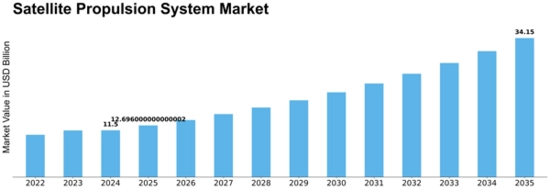
The expanded use of satellites for communication, sensing, navigation and scientific missions has meant greater focus on the technologies that keep them aloft and operational. The Satellite Propulsion System Market is estimated to grow from about USD 11.5 billion in 2024 to roughly USD 34.15 billion by 2035, corresponding to a CAGR of close to 10.4%.
Overview of the Ecosystem
Propulsion systems are the heart of satellite mobility—they enable insertion, station-keeping, orbit altitude adjustments, de-orbiting and repositioning. As satellites migrate from single large platforms to constellations of many small ones, and as mission durations lengthen, propulsion demands increase. The ecosystem stretches from thruster development to integration, from propellant supply to ground-support services.
Key Participants
Leading firms are shaping the market. Aerojet Rocketdyne is noted for innovations in electric propulsion. Northrop Grumman is augmenting its portfolio via acquisitions. Airbus Defence and Space is focusing on sustainable propulsion initiatives. These companies are also likely to collaborate with governments, research institutions and new space entrants, thus anchoring performance, standard-setting and cost structures for the entire industry.
Segmental Growth Focus
Breaking the market down, the propulsion-type segments include cold gas (still the largest), pulsed plasma thrusters, green liquid propulsion, water electrolysed systems, hydrazine micro-electrospray, iodine Hall thrusters, solar sail propulsion and ambipolar thrusters. Cold-gas systems maintain dominance because of heritage and proven reliability; green liquid systems are fastest expanding on account of sustainability and future-proof propellant design. On the regional front, North America ~45 %, Europe ~30 %, Asia-Pacific ~20 %, and Rest of World ~5%.
Outlook and Strategic Implications
The market’s upward trajectory is underpinned by several dynamics: small-satellite proliferation, more frequent launches, more ambitious interplanetary missions, and sustainability imperatives. Companies able to deliver propulsion systems with lower mass, longer endurance, higher reliability and cleaner footprints stand to benefit. The competitive narrative will shift toward design-differentiation, modularity, responsive supply-chains and full-mission lifecycle considerations. For investors and ecosystem players, propulsion is becoming the lever of space-economy growth.
Conclusion
As the satellite market continues to scale, so will the demand for sophisticated propulsion systems. The outlook is positive, the growth strong and the change transformational. Those positioned today to invest in propulsion innovation will help shape the future of satellite mobility—and of the broader space economy.

 English
 Arabic
 French
 Spanish
 Portuguese
 Deutsch
 Turkish
 Italiano
 Russian
 Romaian
 Portuguese (Brazil)
 Greek
Greek