


A Complete Analysis of Export Advance Authorisation Scheme in India
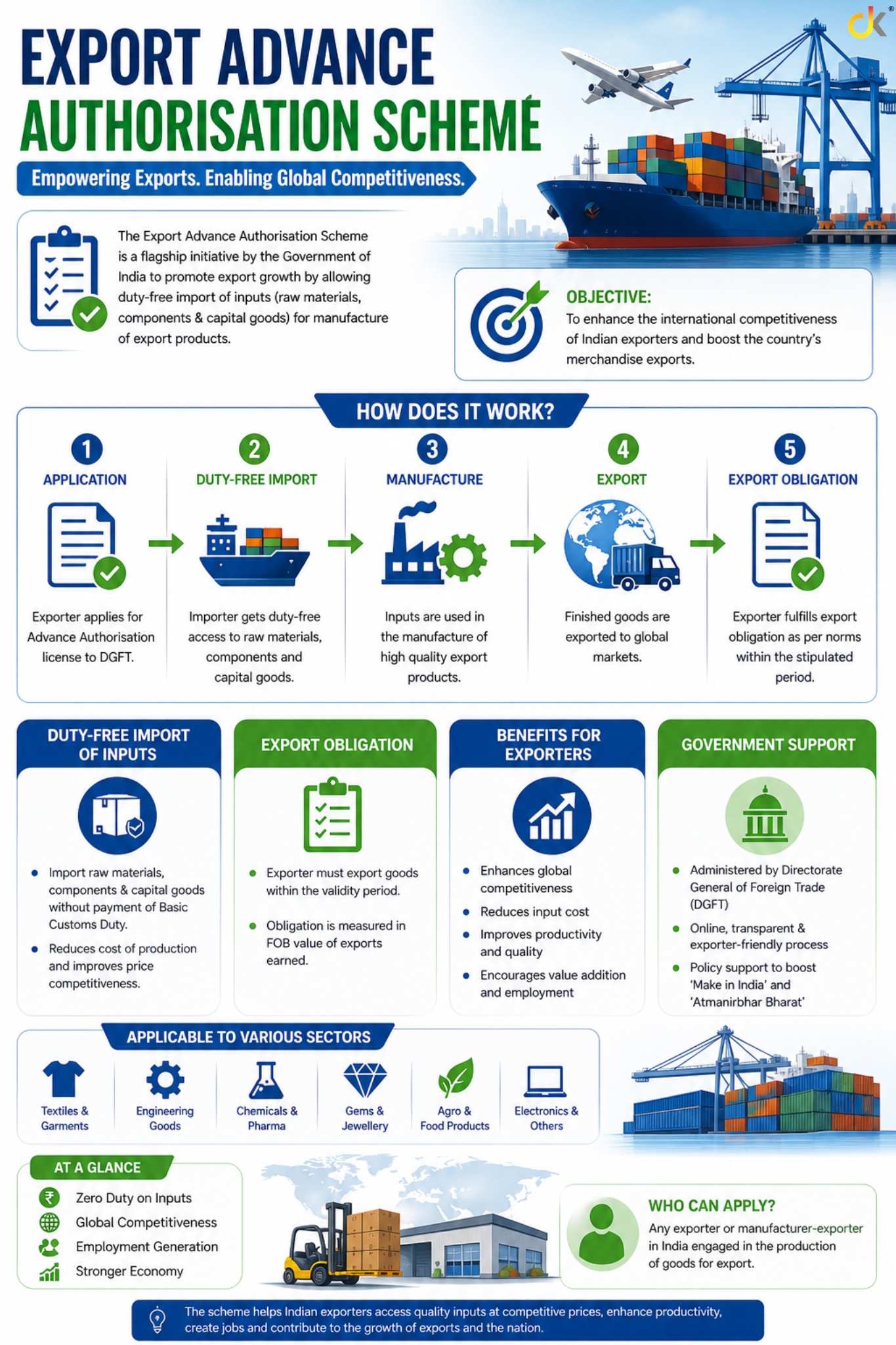
The advance authorization scheme is one of India's most powerful export promotion tools, allowing manufacturers to import duty-free raw materials and inputs specifically for producing export goods. If you are an exporter, a trade compliance professional, or a student preparing for competitive exams, understanding how this scheme works is essential to leveraging its full potential. This comprehensive guide breaks down every critical aspect — from eligibility and benefits to GST implications and export obligations.
What Is the Advance Authorisation Scheme?
The advance authorization scheme is administered by the Directorate General of Foreign Trade (DGFT) under the Foreign Trade Policy (FTP) of India. It permits the duty-free import of inputs — including fuel, oil, energy sources, and catalysts — that are physically incorporated into the export product or consumed during the production process.
The scheme operates on the principle of "actual user condition," meaning the imported inputs cannot be transferred or sold and must be used solely for the purpose of fulfilling the export obligation.
Key features at a glance:
-
Issued to a manufacturer-exporter or a merchant-exporter tied to a supporting manufacturer
-
Covers both physical exports and deemed exports
-
Includes a Standard Input Output Norms (SION)-based or self-declared input-output ratio
-
Validity: 12 months for import and 18 months for fulfilling export obligation
-
Minimum value addition of 15% is mandatory (with certain exceptions)
Advance Authorisation Scheme Under GST
One of the most discussed aspects in recent years is the advance authorisation scheme under GST. After the introduction of GST in 2017, significant changes were made to how the scheme integrates with the new tax framework.
Under GST, imports made against an advance authorisation are exempt from IGST and Compensation Cess, provided the imports are made before the scheme's expiry. This is governed by Notification No. 79/2017-Customs.
Important GST-related considerations:
-
Inputs imported under the scheme are not subject to GST at the port of entry
-
Domestic procurement against an Advance Release Order (ARO) is treated as a deemed export under GST, entitling the supplier to refund of taxes
-
Any unutilized advance authorization cannot be used to claim input tax credit (ITC)
-
Non-fulfillment of export obligation leads to recovery of IGST along with applicable interest
The interplay between the advance authorisation and GST compliance requires careful documentation and timely filing of export realisation certificates (e-BRC) and shipping bills.
Export Obligation Under Advance Authorisation
The export obligation under advance authorisation is a legally binding commitment that the authorization holder must fulfill within the stipulated time. Failure to do so results in penalties, including payment of customs duty along with interest.
How export obligation is calculated:
The export obligation is defined in terms of:
-
Quantity obligation — the amount of goods that must be exported
-
Value obligation — the FOB (Free on Board) value of exports must be at least 15% more than the CIF (Cost, Insurance, Freight) value of imports
Timeline for fulfillment:
|
Phase |
Time Allowed |
|
Import of inputs |
12 months from date of issue |
|
Fulfillment of export obligation |
18 months from date of issue |
|
Extension (if applicable) |
Up to 24 months with DGFT approval |
Consequences of non-fulfillment:
-
Recovery of customs duty with 15% interest per annum
-
Cancellation of the authorization
-
Blacklisting from future FTP benefits in severe cases
Exporters must maintain detailed records including bills of entry, shipping bills, e-BRCs, and input consumption statements to demonstrate compliance.
Advance Authorisation Scheme for UPSC Aspirants
The advance authorisation scheme UPSC topic frequently appears in the General Studies Paper 3 under the Indian Economy and Foreign Trade Policy section. Aspirants need to understand both the conceptual framework and current policy updates.
Key points relevant for UPSC:
-
The scheme is part of India's Foreign Trade Policy (FTP 2023), which replaced the earlier FTP 2015–20
-
It supports India's broader goal of "Atmanirbhar Bharat" by boosting export competitiveness without distorting the domestic supply chain
-
The DGFT regularly revises SION norms to align with industry realities
-
The scheme is WTO-compliant as it avoids subsidizing exports directly — it merely neutralizes the duty burden on inputs
-
Related schemes to know: EPCG (Export Promotion Capital Goods), DFIA (Duty Free Import Authorisation), and RoDTEP (Remission of Duties and Taxes on Exported Products)
Sample UPSC-style framing: "Advance Authorisation is a pre-export incentive, whereas DFIA is a post-export facility — both aim to ensure zero-duty import of inputs but differ in timing and transferability."
Read More - 🌟 Complete Guide to the RoSCTL Scheme – Benefits, Process, Application, and More 🚢
Who Should Apply and How?
Eligibility:
-
Manufacturer-exporters with a valid IEC (Importer Exporter Code)
-
Merchant-exporters supported by a supporting manufacturer
-
Applicants with a confirmed export order or Letter of Credit (LC)
Application Process:
-
Register on the DGFT portal (dgft.gov.in)
-
Submit the ANF 4A application form with the required documents
-
Attach export order, IEC copy, and input-output declaration
-
Pay the applicable application fee
-
Obtain the authorization and register it with the customs authority
Documents required:
-
IEC Certificate
-
GST Registration Certificate
-
Bank Account details for bond/BG submission
-
Copy of export order / LC
-
Self-declared or SION-based input-output norms
Conclusion
The advance authorization scheme remains a cornerstone of India's export incentive framework — enabling businesses to compete globally by eliminating the duty cost burden on imported inputs. Whether you are an exporter managing your trade compliance, a chartered accountant advising clients on FTP benefits, or a student preparing for UPSC, mastering this scheme is non-negotiable.
Navigating the advance authorisation scheme requires precision — from ensuring correct input-output norms to timely fulfillment of export obligations and seamless GST compliance. One documentation error or missed deadline can result in significant financial penalties.
This is where Afleo Consultants steps in. As a trusted trade compliance and foreign trade advisory brand, Afleo helps exporters apply for, manage, and close advance authorisations efficiently — ensuring zero compliance gaps and maximum duty savings. From DGFT filings to GST reconciliation and export obligation monitoring, Afleo brings expertise that protects your business and accelerates your export growth.
Frequently Asked Questions (FAQ)
Q1. What is the minimum value addition required under the advance authorization scheme? A minimum value addition of 15% is mandatory. However, certain products like gems, jewellery, and tea have different norms as specified in the Handbook of Procedures.
Q2. Can an advance authorisation be transferred or sold? No. The scheme operates under the "actual user condition," which means the imported inputs cannot be sold, transferred, or used for any purpose other than the specified export production.
Q3. Is IGST payable on imports made under advance authorisation? No. Imports under a valid advance authorisation are exempt from IGST and Compensation Cess, provided the imports are made within the scheme's validity period.
Q4. What happens if the export obligation is not fulfilled on time? The holder must pay all customs duties that were exempted, along with 15% per annum interest from the date of import. The authorization may also be cancelled.
Q5. How is the advance authorisation scheme different from DFIA? Advance Authorisation is a pre-export benefit (issued before export), while DFIA (Duty Free Import Authorisation) is a post-export benefit (issued after meeting export obligation). Additionally, DFIA inputs are transferable after the export obligation is completed, unlike advance authorisation inputs.
Q6. Can service exporters avail the advance authorization scheme? No. The scheme is specifically available for goods exporters — manufacturers and merchant-exporters dealing in physical goods. Service exporters have separate incentive mechanisms under the FTP.
Q7. Where can I apply for an advance authorisation? Applications must be submitted online through the official DGFT portal at dgft.gov.in using the ANF 4A form.

 English
 Arabic
 French
 Spanish
 Portuguese
 Deutsch
 Turkish
 Italiano
 Russian
 Romaian
 Portuguese (Brazil)
 Greek
Greek