


How Regression Testing Helps Maintain Application Stability Over Time?
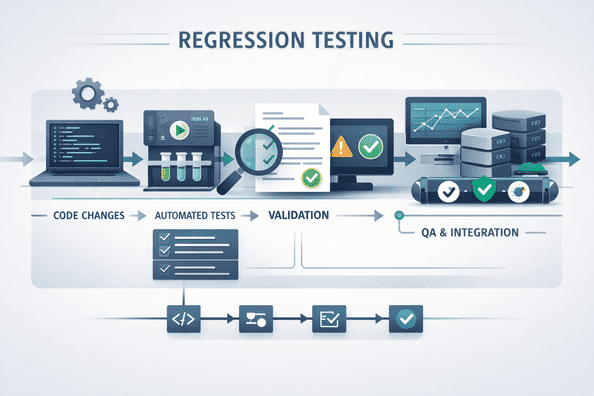
As software evolves with new features, updates, and bug fixes, maintaining application stability becomes increasingly challenging. Even small code changes can unintentionally break existing functionality. This is where regression testing plays a critical role.
By continuously validating existing features after every change, regression testing ensures that applications remain stable, reliable, and consistent over time.
Why Application Stability Matters
Stable applications provide:
- Consistent user experience
- Fewer production issues
- Reliable performance
- Higher user trust
Without stability, frequent updates can introduce risks that impact both users and business outcomes.
What Is Regression Testing
Regression testing is the process of re-running previously executed test cases to ensure that new code changes have not affected existing functionality.
Key Objectives
- Detect unintended side effects of changes
- Ensure existing features continue to work
- Maintain system reliability over time
It acts as a safety net for ongoing development.
How Regression Testing Maintains Stability
Let’s explore how regression testing contributes to long-term application stability.
1 Continuous Validation of Existing Features
Every update introduces potential risks.
How It Helps
- Re-tests critical functionalities after changes
- Ensures previously working features remain intact
Impact
Prevents regressions from reaching production.
2 Early Detection of Breaking Changes
Regression testing identifies issues as soon as they are introduced.
Benefits
- Faster debugging
- Reduced cost of fixing defects
- Improved development efficiency
Early detection is key to maintaining stability.
3 Supports Frequent Releases
Modern development involves rapid and continuous releases.
How It Helps
- Validates code changes in every release cycle
- Ensures stability despite frequent updates
This enables teams to release confidently.
4 Ensures Consistent System Behavior
Consistency is essential for a stable application.
Benefits
- Same functionality behaves the same way across versions
- Eliminates unexpected changes in behavior
This builds reliability over time.
5 Improves Test Coverage Over Time
Regression test suites grow as applications evolve.
What It Covers
- Core workflows
- Edge cases
- Integration points
Improved coverage reduces the chances of undetected issues.
6 Supports Integration Stability
Applications often rely on multiple systems and services.
How It Helps
- Validates interactions between components
- Ensures changes do not break integrations
This is crucial for complex systems.
7 Complements Black Box Testing
Regression testing often incorporates black box testing techniques to validate system behavior from a user perspective.
Benefits
- Focus on inputs and outputs
- Validation of real-world scenarios
- Ensures functionality remains intact
This combination strengthens stability and reliability.
8 Enables Automation for Scalability
Manual regression testing is not scalable.
Role of Automation
- Executes large test suites quickly
- Enables frequent test runs
- Provides consistent results
Automation ensures regression testing remains efficient as systems grow.
Common Challenges
Teams may face challenges such as:
- Increasing test suite size
- Longer execution times
- Maintaining test cases
- Managing test environments
Addressing these challenges is essential for long-term stability.
Best Practices for Maintaining Stability
To maximize the effectiveness of regression testing:
- Prioritize critical test cases
- Automate repetitive tests
- Maintain and update test suites regularly
- Use parallel execution to reduce runtime
- Integrate testing into CI CD pipelines
These practices ensure efficient and reliable testing.
Real World Example
Consider a SaaS application with frequent feature updates.
Without Regression Testing
- New features break existing functionality
- Increased production bugs
- Unstable releases
With Regression Testing
- Continuous validation of features
- Early detection of issues
- Stable and reliable releases
This highlights the importance of regression testing in maintaining stability.
Role of Modern Tools
Modern tools enhance regression testing by:
- Automating test execution
- Integrating with CI CD workflows
- Providing insights into test performance
For example, platforms like Keploy can generate tests from real API interactions, helping teams maintain stability through realistic validation.
Conclusion
Regression testing is essential for maintaining application stability over time. By continuously validating existing functionality, detecting issues early, and supporting frequent releases, it ensures that software remains reliable as it evolves.
In modern development environments, where change is constant, regression testing acts as a safeguard—helping teams deliver stable, high-quality applications with confidence.

 Arabic
 French
 Spanish
 Portuguese
 Deutsch
 Turkish
 Dutch
Dutch
 Italiano
 Russian
 Romaian
 Portuguese (Brazil)
 Greek
Greek