


Industrial Networking in Oil Refineries with RS‑485 to Ethernet Converters
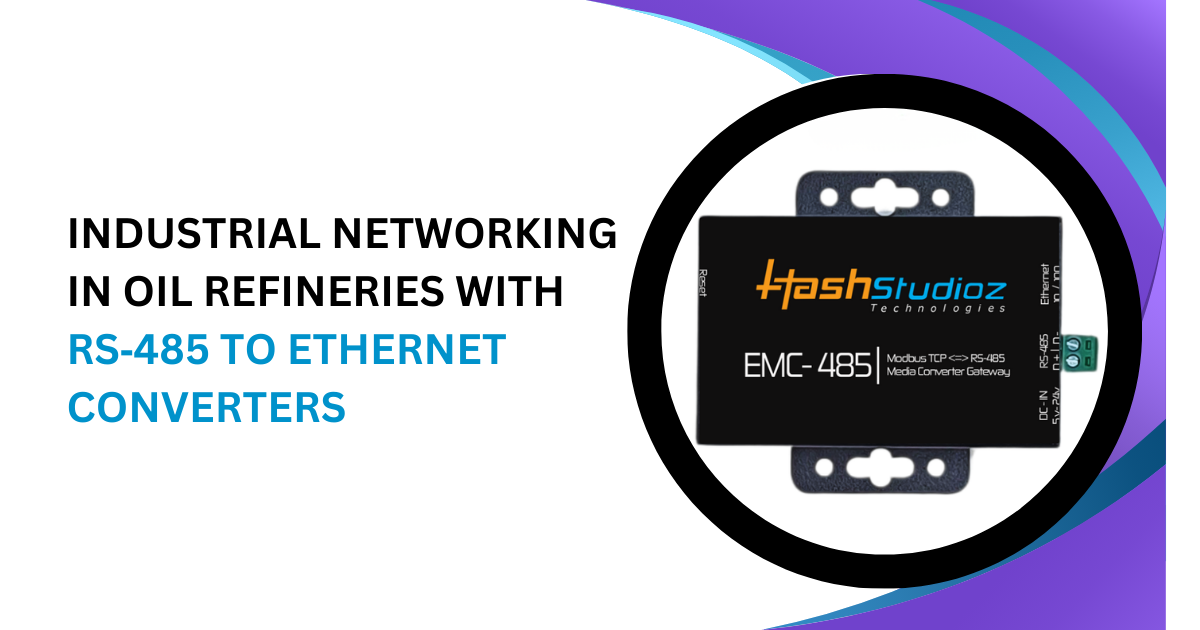
Industrial networks in oil refineries must handle heavy data flow, extreme conditions, and strict safety needs. Reliable communication between devices and control systems drives every stage of refining. The proper networking strategy reduces downtime, improves monitoring, and increases operational performance. In this article, we discuss how industrial communication evolves in oil refining and the key role played by RS‑485 to Ethernet Converter and RS‑485 to Lan Converter devices.
What is Industrial Networking in Refineries?
Industrial networking is the system of devices, sensors, controllers, and communication methods that share data throughout a refinery. In oil refining, this network must connect:
-
Programmable Logic Controllers (PLCs)
-
Distributed Control Systems (DCS)
-
Human Machine Interfaces (HMIs)
-
Remote terminal units (RTUs)
-
Sensors and actuators
These devices collect and exchange data for control, reporting, safety, and automation.
Why is Networking Vital?
Oil refineries handle dangerous materials at high temperatures and pressures. Operators must watch process variables in real time. Proper networking ensures:
-
Real‑time monitoring
-
Accurate control loops
-
Quick fault detection
-
Efficient maintenance planning
A survey by ARC Advisory Group shows that over 70% of process manufacturers now use modern digital field devices connected via industrial networks.
Traditional Serial Communication: RS‑485
Before Ethernet, serial communication dominated industrial networks. RS‑485 became the industry choice for its durability and multi‑drop support.
Key Traits of RS‑485
-
Supports differential signaling
-
Works over long cable runs up to 1200 meters
-
Handles up to 32 devices on one bus
-
Works well in noisy electrical environments
RS‑485 remains common because many older modules, sensors, and PLC I/O devices use it. However, it has limits:
-
Lower data rates compared to Ethernet
-
Harder to integrate with modern control systems
-
Limited remote access support
Ethernet in Industrial Networking
Ethernet has become the backbone of modern industrial communication. It supports higher speed, robust topology options, and internet compatibility.
Why Ethernet is Preferred
|
Feature |
Ethernet |
RS‑485 |
|
Data Rate |
Up to 10 Gbps |
Up to 10 Mbps |
|
Network Size |
Thousands of nodes |
~32 devices |
|
Remote Access |
Easy |
Limited |
|
Standardization |
Strong |
Moderate |
Ethernet allows devices to connect in star, tree, or ring topologies. It supports TCP/IP, which is the standard for network communication worldwide. Many modern SCADA, PLC, and cloud analytics tools require Ethernet connectivity.
The Need for Protocol Conversion
Even though Ethernet excels in speed and scale, many field devices still use RS‑485. Replacing all of them can be costly and risky. The solution is to use converters that bridge RS‑485 and Ethernet networks. These devices share data between serial and Ethernet devices without disrupting operations.
What is an RS‑485 to Ethernet Converter?
An RS‑485 to Ethernet Converter is a device that connects RS‑485 devices to an Ethernet network. It translates serial data into packets that Ethernet devices understand. These converters preserve original data formats while making the data accessible to modern networks.
Core Functions
-
Bidirectional conversion between RS‑485 and Ethernet
-
Protocol support for Modbus RTU/TCP, DNP3, PROFIBUS, etc.
-
Network transparency so serial devices behave normally
-
Remote access for configuration and monitoring
Neutral converters allow legacy devices to operate on current networks with minimal changes.
RS‑485 to Lan Converter: A Useful Alternative
The term RS‑485 to Lan Converter refers to the same category of device but highlights the LAN connection focus. These converters connect RS‑485 devices directly to a local area network (LAN) without intermediate gateways.
The major benefit of a LAN converter is simplicity. When a refinery network uses standard LAN switches and routers, RS‑485 devices integrate directly. The converter then becomes a localized protocol translator.
How Conversion Works: A Technical View
To understand industrial conversion, consider the following data path:
-
RS‑485 sensor sends binary data.
-
Converter receives the data and buffers it.
-
Converter wraps data into Ethernet‑compatible frames.
-
Frames are sent via TCP/IP or UDP over the industrial network.
-
A PLC or server receives the Ethernet packets and processes the information.
Because industrial Ethernet uses deterministic protocols like Profinet, EtherNet/IP, and Modbus TCP, the converter must also support these standards or bridge protocols smoothly.
Deployment Scenarios in Oil Refineries
Oil refineries have several areas where RS‑485 to Ethernet conversion is valuable:
1. Tank Farm Monitoring
Tank farms have level sensors, temperature probes, and pressure transmitters.
-
Most field devices communicate via RS‑485.
-
The converter sends data to a central control room via Ethernet.
-
Operators get real‑time metrics and alarms.
2. Burner Control Units
Burners regulate heat in furnaces. They use RS‑485 to talk with PLCs.
-
Converters extend connectivity to remote diagnostics.
-
Technicians can test performance without entering hazardous zones.
3. Flare Gas Systems
The flare system burns excess hydrocarbons. It uses flow meters, temperature sensors, and valves.
-
RS‑485 can connect sensors along long pipelines.
-
A converter links the devices to the refinery DCS.
Real‑World Example: Modbus Integration
Modbus is one of the most common industrial protocols. Many sensors speak Modbus RTU over RS‑485. Modern control systems prefer Modbus TCP over Ethernet.
In an actual refinery:
-
40 level sensors communicate using Modbus RTU.
-
These connect to 5 RS‑485 to Ethernet Converters.
-
Each converter serves 8 sensors on a bus.
-
Converters relay data to a central SCADA server.
This setup increases system reliability and allows remote diagnostics. According to recent industrial surveys, about 52% of refinery networks use Modbus TCP for data aggregation. (Source: ARC Advisory Group)
Industrial Network Design Considerations
To implement converters in oil refineries effectively, engineers must consider:
1. Network Architecture
Ethernet infrastructure can be designed in:
-
Star topology with centralized switches
-
Ring topology with redundancy
-
Mesh topology for high availability
Converters should fit into the chosen layout and follow the redundancy plan.
2. Encryption and Security
Converters sometimes expose serial devices to Ethernet networks. Without safeguards, this could lead to:
-
Unauthorized access
-
Command injection
-
Data manipulation
Security measures include:
-
Network segmentation (VLANs)
-
Firewalls between networks
-
Secure credentials for converter access
Cybersecurity Analytics for Oil & Gas reports that 40% of industrial network breaches result from unsecured devices. (Source: Cybersecurity Analytics for Oil & Gas)
3. Power and Environmental Conditions
Converters must tolerate refinery conditions:
-
High temperatures
-
Humidity
-
Electrical noise
-
Vibration
Industrial versions support wide voltage ranges and rugged enclosures. Many operate from 9 to 36 VDC to match field power systems.
Statistics on Industrial Networking
Industrial communication has expanded rapidly. Key statistics include:
-
Industrial Ethernet adoption grew to 64% in process industries by 2024.
-
RS‑485 remains active in over 78% of legacy sensors and controllers.
-
The use of remote monitoring via Ethernet increased by 28% over three years.
These numbers show that while Ethernet grows, RS‑485 devices continue to operate. Converters bridge this gap effectively.
Protocols Supported by Converters
Converters often support multiple protocols:
-
Modbus RTU (RS‑485) and Modbus TCP (Ethernet)
-
DNP3
-
PROFIBUS DP
-
BACnet
-
Custom serial protocols
The ability to translate many protocols makes converters flexible. Without them, engineers would need complex gateway units or full device replacements.
Challenges and Best Practices
Deploying converters in refineries can be complex. Common challenges include:
1. Timing and Synchronization
Converters can introduce latency. It’s important to:
-
Choose devices with low buffering delay
-
Use sampling rates that match process requirements
2. Addressing and Configuration
Each converter and device must have unique network addresses. Best practices are:
-
Use a central documentation sheet
-
Assign static IPs
-
Label all converters in the field
3. Maintenance and Firmware Updates
Converters require periodic updates. Always:
-
Test new firmware in a lab
-
Backup configuration files
-
Update outside of peak operating hours
Regular maintenance increases long‑term stability.
Future Trends in Oil Refinery Networking
Emerging trends will affect how converters are used:
1. Industrial IoT Adoption
Industrial IoT (IIoT) will connect more devices to cloud platforms.
-
Data analytics improves efficiency
-
Predictive maintenance triggers before failures
-
RS‑485 devices can connect via converters
2. Virtualization and Edge Computing
Edge devices process data near the source. Converters may pair with:
-
Edge gateways
-
Local databases
-
Real‑time processing units
These reduce data traffic and server load.
3. Cybersecurity Integration
Converters will include stronger security:
-
Built‑in VPN support
-
Secure boot mechanisms
-
Better encryption
These steps will minimize risk from external attacks.
Conclusion
Industrial networking in oil refineries often mixes legacy and modern communications. RS‑485 devices remain in the field because they are rugged and proven. However, Ethernet is necessary for fast, scalable, and remote access systems.
An RS‑485 to Ethernet Converter or RS‑485 to Lan Converter provides the needed bridge. These devices make older equipment accessible to modern networks, avoid costly replacements, and ensure that data flows reliably from the field to control rooms and servers.

 English
 Arabic
 French
 Spanish
 Portuguese
 Deutsch
 Turkish
 Dutch
Dutch
 Italiano
 Russian
 Portuguese (Brazil)
 Greek
Greek